
About
In the lead-up to the 2024 U.S. federal general election, the digital landscape became the primary battleground for candidate communication. While much of the public focus remained on campaign rhetoric, a team of researchers at Emory University sought to uncover a deeper layer: how are candidates actually mobilizing citizens to participate in the democratic process?
Challenge
In the high-stakes environment of a U.S. federal election, understanding how candidates communicate with the electorate is vital for democratic transparency. However, monitoring this behavior presents a massive data hurdle. Leveraging Bright Data’s X and Facebook Web Scrapers, Emory University researchers accessed and analyzed 20,000 social media posts from 2024 political candidates accounts.
Students at Emory developed a sophisticated labeling architecture to process the dataset. This pipeline moved beyond simple “political vs. non-political” labels, diving into the specific anatomy of civic communication:
- Screened posts for civic relevance
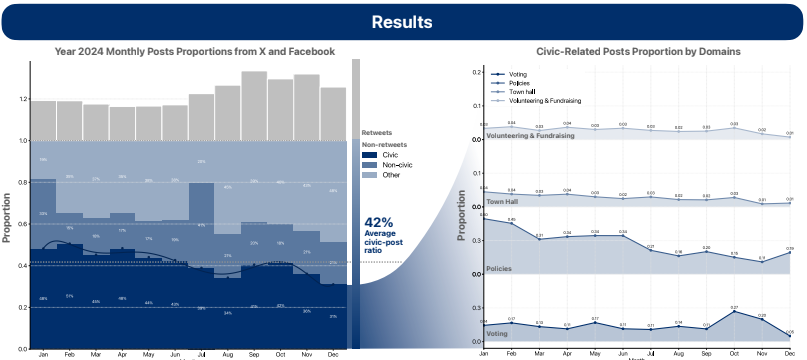
- Classified the content by domain (Voting, Town Halls, Volunteering & Fundraising, Policy)
- Applied intent labels distinguishing Calls to Action, Reports, and Appreciation
Impact
The collaboration yielded a dataset that provides a rare, empirical look at the 2024 election cycle. By combining human-in-the-loop coding with AI efficiency, the project achieved several milestones:
- Created a replicable AI pipeline for classifying civic engagement on social media, now used to support ongoing monitoring and future electoral cycles.
- Revealed key communication patterns in candidate posts, including the finding that ~40% of all candidate posts are civic in nature
- Provided empirical insight into how candidate communication evolves over the election year, distinguishing electoral mobilization from broader civic engagement content.
- Strengthened methodological bridges between academic research and applied civic-tech monitoring for democratic accountability.