
As political communication increasingly moves onto digital platforms, the way public officials communicate online has become central to how citizens understand public events, evaluate claims, and engage with democratic institutions. Social media platforms are no longer just channels for public statements – they are spaces where trust is built, challenged, and sometimes undermined.
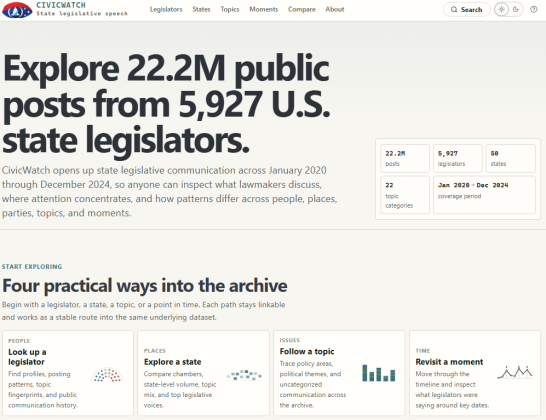
Researchers at the University of Pittsburgh developed CivicWatch, a data analytics platform designed to help scholars, journalists, civic organizations, and the broader public better understand how elected officials use social media to communicate. By combining large-scale data collection, computational analysis, and cross-platform research, CivicWatch provides a clearer view into the digital behavior of public officials and its impact on democratic life.
The Challenge:
CivicWatch provides transparency into how more than 10,000 U.S. public officials use social media to communicate with citizens. The platform helps researchers examine how officials share information, engage with constituents, and respond during high-stakes moments such as close elections, public emergencies, or periods of social tension. With more than 20 million tweets connected to U.S. state-level elected officials, CivicWatch enables users to explore political communication patterns at scale.
Building and maintaining this kind of live analytics dashboard requires large, reliable, and consistent public web data. Unlike a one-time research dataset, CivicWatch depends on ongoing data collection to keep insights current and support longitudinal analysis. This reliability is especially important for research focused on public trust, misinformation risk, democratic accountability, and the role digital platforms play in shaping civic discourse.
The Solution:
The University of Pittsburgh research team uses Bright Data’s ready-made scrapers to collect structured public web data from major digital platforms across several research projects. This allows access to data at scale while reducing the engineering burden of collecting information from complex and frequently changing online platforms.
Across their broader research program, the team has used Bright Data to collect more than 2 million records, including approximately 1.5 million political tweets from G7 politicians for a study on political communication and language use, and around 500,000 short-form video records from across social media for research comparing human-created and AI-generated religious content.
For CivicWatch, Bright Data’s data collection infrastructure supports a dashboard that lets users explore social media activity by U.S. state-level elected officials. The platform gives researchers a centralized way to analyze communication patterns, compare activity across officials and regions, and better understand how elected leaders engage with citizens online.
The Impact:
As a public platform, CivicWatch gives researchers, journalists, civic organizations, and the broader public a new way to understand political discourse online — at both the macro and micro level. At the macro level, the platform enables users to identify broader trends in how elected officials communicate across states, parties, regions, and time periods. This can help reveal patterns in public messaging, engagement, transparency, and the spread or correction of contested claims during important civic moments.
At the micro level, CivicWatch allows users to examine the communication behavior of individual officials, including how they engage with constituents, respond to events, and use social platforms to shape public narratives. This level of visibility can support more informed analysis of accountability, representation, and trust in democratic institutions.
By making large-scale social media activity more accessible and easier to analyze, CivicWatch helps turn public web data into a resource for civic understanding. It makes online political communication more transparent, searchable, and accountable – supporting evidence-based analysis of how digital platforms shape democratic discourse.